
Oil, Iran, and the Global Forces Shaping Travel Demand
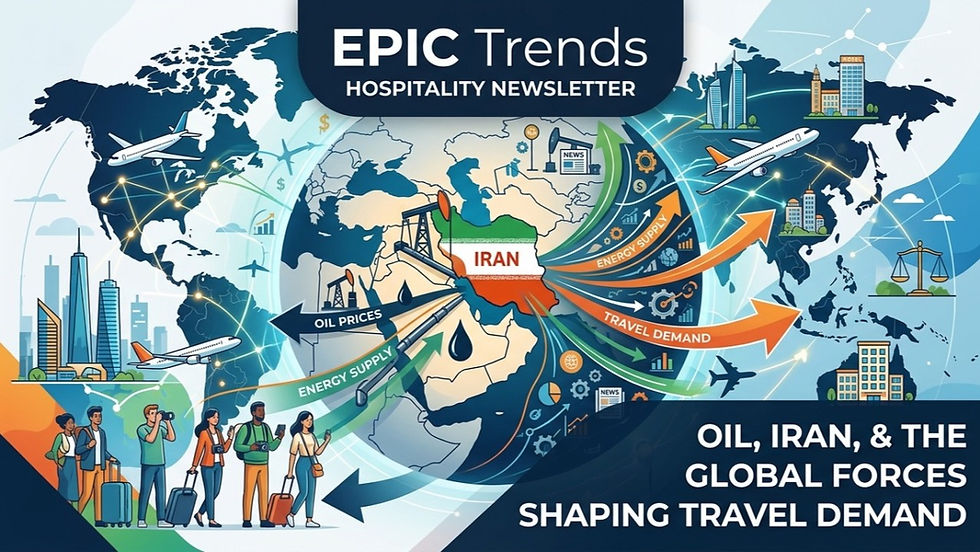
Every industry has early warning signals. In hospitality, one of the most reliable ones isn’t found in STR reports, booking pace, or airline schedules.
It’s the price of oil.
Over the past week, rising tensions involving Iran have pushed oil prices sharply higher, once again reminding markets how quickly geopolitical events can ripple through the global economy. For the travel industry, those movements matter more than most people realize. Hospitality may feel like a local business; guests arriving at a hotel, checking in, ordering room service but in reality it sits at the center of a complex global system built on transportation, energy, and consumer confidence.
When oil prices move, that system begins to adjust.
The Airline Effect on Travel Demand
The first impact is almost always felt in aviation.
Jet fuel typically represents 20–30% of airline operating costs, making it one of the largest expenses on an airline’s balance sheet. When oil prices climb quickly, airlines initially absorb some of the cost through hedging strategies and capacity management. But if elevated prices persist, those increases inevitably find their way into ticket prices. Historically, sustained increases in oil prices translate into higher airfares within a matter of months.
When that happens, travel behavior changes.
Long-haul trips become more carefully planned. Travelers take fewer but more intentional vacations. Domestic travel often gains relative strength, while destinations dependent on long-distance air access can see softer demand.
These adjustments rarely happen overnight, but they tend to appear gradually across the following quarters.
Uneven Impact Across Hotels
The hospitality industry never moves as a single unit during moments like this.
Luxury hotels often remain resilient. Higher-income travelers tend to be less sensitive to airfare fluctuations, and in some cases they respond to uncertainty by prioritizing meaningful travel experiences rather than postponing trips altogether. The pressure is more likely to emerge in the middle of the market.
Properties dependent on long-haul leisure demand, large group travel, or international arrivals are typically the first to feel shifts in booking behavior. Destinations reliant on significant airlift may also see changes in travel patterns as consumers become more selective about where and how far they travel.
At the same time, rising energy costs do not only affect guests.
Hotels themselves begin to feel the impact through higher operating costs, energy consumption, transportation, food supply chains, and logistics, all move in tandem with broader energy markets. Over time, those pressures can quietly compress operating margins across the sector.
Strategy Matters More During Uncertainty
Periods of macroeconomic or geopolitical volatility often test the discipline of hotel operators.
When demand becomes less predictable, the instinct to lower prices in order to maintain occupancy can be strong. Yet history suggests that aggressive discounting rarely produces sustainable demand. More often, it erodes pricing power and delays recovery.
Hotels that navigate these periods successfully tend to focus on three strategic principles:
Protecting rate integrity rather than chasing occupancy
Shifting toward resilient demand segments, particularly domestic and drive markets
Enhancing the value of the guest experience, ensuring that the trip feels worth the cost of travel
When travel becomes more expensive, guests do not necessarily stop traveling, they simply become more selective.
Hotels that offer a compelling reason to visit are the ones that continue to perform.
Watching the Right Signals
For hospitality leaders, moments like this serve as a reminder that the industry is deeply connected to broader global forces. Energy markets, geopolitical tensions, airline network decisions, and currency movements can influence travel demand as much as marketing strategies or distribution channels. These factors rarely appear in daily operational reports, but they often shape the environment in which those reports are produced.
In many cases, the earliest signals appear long before they show up in hotel booking data. Sometimes they appear in airline capacity changes. And sometimes they appear in the price of oil.
Because when oil moves, travel eventually follows.
Thank you for reading this edition of EPIC Trends. I invite you to subscribe to EPIC Trends so you never miss future perspectives on revenue, distribution, and the evolving world of hospitality.


rr88 com mình thấy bạn bè nhắc hoài nên cũng bấm vào coi thử cho biết thôi. Không có ngồi lâu hay tìm hiểu sâu gì, chủ yếu lướt xem giao diện ra sao. Cảm giác đầu tiên là nhìn khá dễ chịu, bố cục thoáng nên không bị “ngợp” như nhiều trang khác. Mình thích cái cách họ chia nội dung thành từng khối rõ ràng, kéo xuống tới đâu biết mình đang ở đoạn nào tới đó, khỏi phải quay lên quay xuống. Với lại menu để chỗ dễ thấy nên chuyển qua lại cũng nhanh, nhất là lúc mình mở bằng điện thoại. Nói chung lướt vài phút thấy ổn, nhìn gọn mắt, và mấy khung thông…
kèo nhà cái nhìn qua thì mình thấy giống mấy trang tin kèo mình hay lướt trước đây. Vừa vào mình để ý ngay cái menu đặt lộ rõ ở trên nên bấm qua lại nhanh, kiểu đang xem dở cũng không phải mò mẫm tìm đường về, và mấy mục chính hiện ra rõ ràng nên người mới vào cũng đỡ phải đoán. Kéo xuống một lúc thì thấy họ trình bày theo dạng ô với danh sách nên mắt bắt thông tin khá nhanh, không bị kiểu chữ dồn dập làm mỏi, nhìn phát là biết đoạn nào là tiêu đề đoạn nào là phần nội dung. Nói chung mình chỉ lướt vài phút cho vui thôi mà…